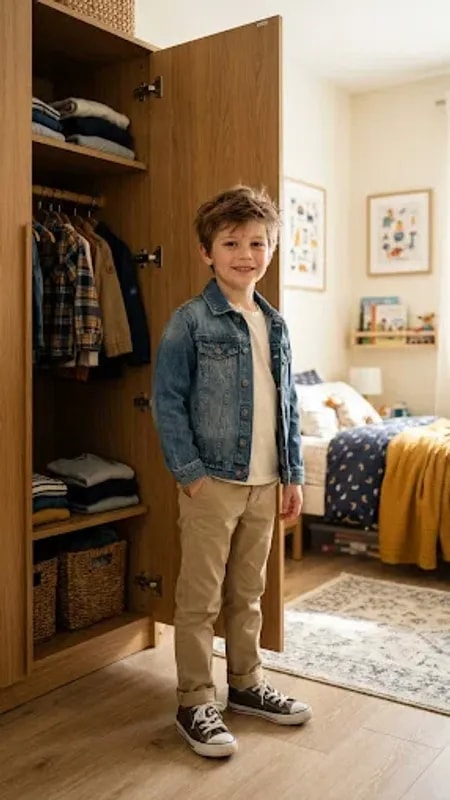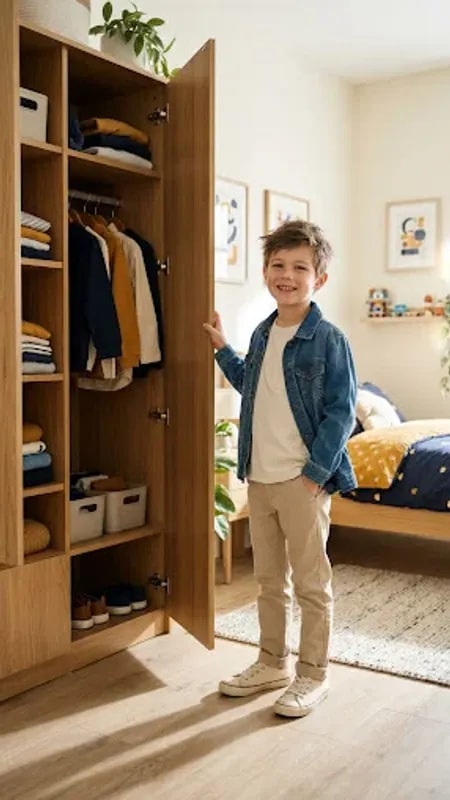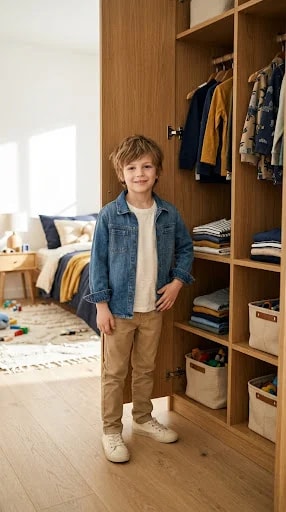
Look closely at the boy standing in front of his open closet and you notice something beyond the neat stacks: nothing in that wardrobe is out of his reach. The hanging rail sits low enough for him to lift a hanger down himself, the folded piles land at chest height, and the woven bins on the bottom shelf hold things he's allowed to grab without asking. That single design decision does more for a boys' wardrobe than any amount of matching hangers or color-coded labels. A closet a child can operate is a closet that stays reasonably orderly, because putting things away stops feeling like a chore handed down from above.
The outfit he's wearing is worth stealing outright: a denim jacket over a plain white tee, khaki trousers, white sneakers. It's the kind of formula that works for school drop-off, a birthday party, and a restaurant dinner without a single change, and every element is sturdy enough to survive a playground. Build the hanging rail around four or five combinations like this — jacket plus tee plus trousers, sweatshirt plus joggers, a button-down for the days that call for one — and let him choose which version he wants. The navy, mustard, and patterned pieces visible on the rail all read as variations on the same idea rather than a pile of unrelated clothes, which is why they mix without effort.
Then there's the question of what shares the room with the clothes. Those woven bins in the lower cubbies are doing quiet, important work: they hold toys, which keeps the wardrobe from becoming a general dumping ground. When playthings have their own containers on the floor level and garments live above, a boy learns the difference fast. The bedroom behind him — the bed with its yellow throw, the rug, the scattered toys — shows the honest reality of a lived-in space. The wardrobe doesn't need to be museum-perfect; it needs clear zones.
Editing matters as much as arranging. Keep eight to ten hanging pieces in rotation and pull the rest for the season, because a crowded rail is the fastest way to make a child give up on choosing. Folded stacks should stay shallow enough that pulling one shirt doesn't topple the pile. And leave one empty cubby, always. It gives him somewhere to put the clothes he's decided against, instead of dropping them on the rug.
The payoff is a morning that runs itself. He walks over, opens the door, and builds an outfit from pieces he already knows how to combine — and the confidence in that smile is the whole point.