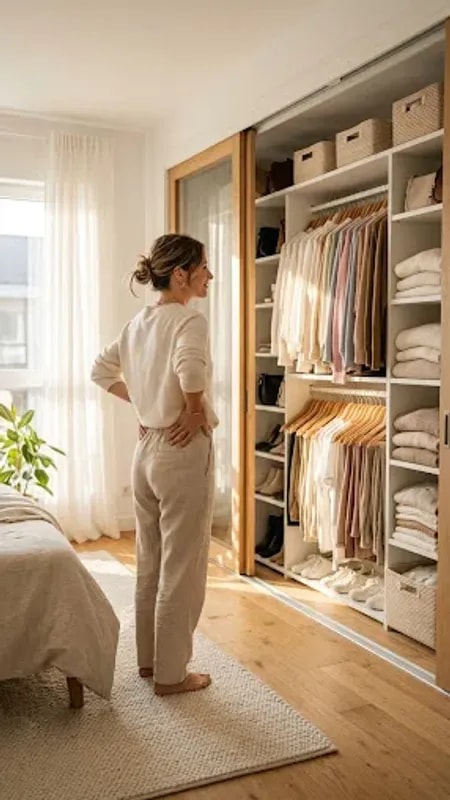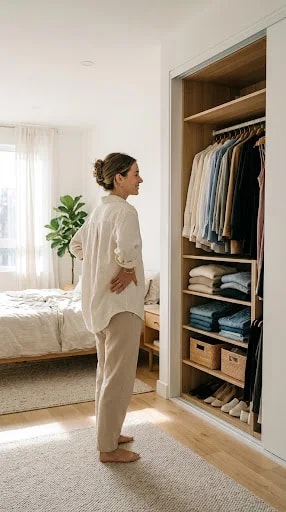
The doors slide, and the morning starts quietly. A woman stands barefoot on the bedroom floor, one hand loose at her side, looking into a wardrobe whose wood frame is the warmest thing in the room. What she sees is not a tangle of hangers but a composed interior: softly colored clothes along the upper rail, folded stacks squared away on shelves, woven baskets holding whatever shouldn't be on show, shoes lined up like a small library. This is the quiet argument for sliding doors in a single image — they conceal everything, so the inside has to earn the reveal.
The most common mistake with a sliding wardrobe is planning it like a hinged one. Bypass panels mean you only ever see part of the interior at once, so each bay needs its own complete logic rather than one long horizontal run of rail. Give every column a full vertical story: hanging at the top, a shelf at eye level for folded knits and linen, a drawer or basket below for the things that never hang well. Then set aside one bay for the long pieces — coats, dresses, anything that needs height — so the rest can be built around shorter garments and gain an extra shelf in the process.
The hardware deserves honest attention. Sliding tracks consume six to ten centimetres of depth at the opening, which is exactly the space people forget to subtract before ordering interiors. Plan around sixty centimetres of clear depth where clothes hang and a shallower thirty-five for folded stacks, and choose soft-close runners so a door never slams while someone is still asleep. A wood-framed opening, as in this bedroom, gives the mechanism a place to live without turning the wall into a technical detail.
Inside, restraint reads as luxury. Warm oak against creamy white shelving, baskets in oat and sand, garments kept loosely within one family of tones — none of it is expensive, and all of it looks considered. Keep the doors themselves plain, since a quiet surface lets the bedroom stay quiet too, and let the morning light coming through the sheer curtains do the decorating.
What the photograph really captures is a smaller decision count. Everything has a place, so getting dressed becomes a short, calm sequence instead of a search. Slide one panel, reach, choose, close it again. The room is left as it was found: bed rumpled, plant green on the sill, wardrobe holding its contents neatly behind two warm wooden planes.