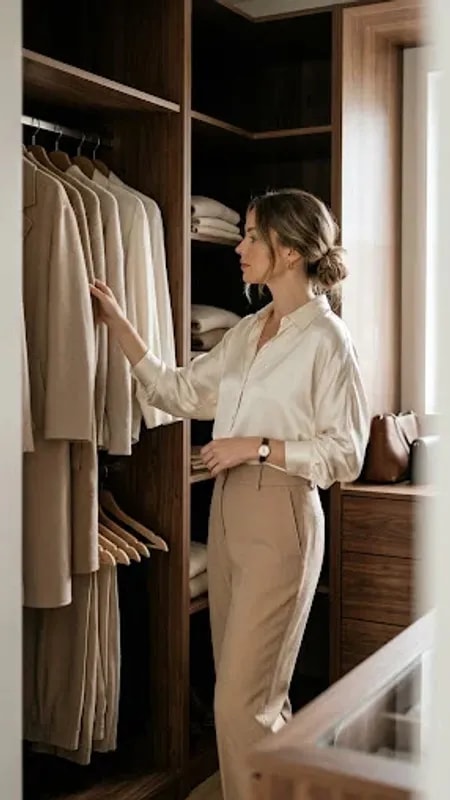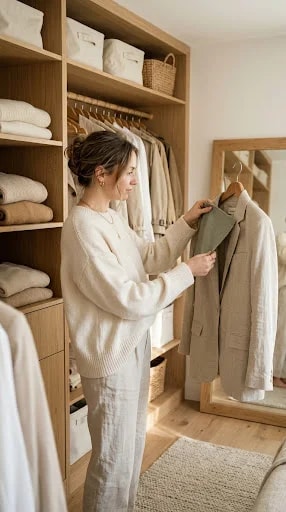
Most wardrobes fail not because of a lack of clothes but because of a lack of structure. The clearest fix is to stop thinking in terms of hanging space and start thinking in shelves. When folded knits, crisp shirts, and pressed trousers sit in open view, you buy differently: you see the gaps, you notice the duplicates, and you naturally gravitate toward pieces that earn their place in the stack. Building your own wardrobe from that visual starting point turns a pile of purchases into a system.
Begin with the palette before you buy anything. Choose three base neutrals — in the photograph, cream, tan, and warm grey — and one accent that reads almost neutral, like a soft grey-blue or a muted olive. Everything else has to work with those four. This single rule does more heavy lifting than any style quiz, because it means your sweaters, shirts, and trousers already talk to each other. Texture then does the work colour usually does: a chunky ribbed knit beside a smooth poplin shirt and a matte wool trouser creates richness without a single loud print.
Next, plan the shelf, not the closet. Measure the interior width and depth, then sketch a vertical rhythm: a tall bay for folded trousers, a shorter bay for knits, a narrow slot for accessories. Folded stacks look intentional when they stay four to five pieces deep — anything taller collapses into a jumble. Leave a few fingers of air between stacks so you can pull a single sweater free without disturbing the rest. Add one small lidded woven basket for odds and ends and a single hook or shelf for a hat, and stop there. Emptiness is part of the design; it is what makes the rest look considered.
Then comes the honest part: the edit. Turn every item over and ask two questions — did I wear it in the last twelve months, and does it belong to the four-colour palette? Anything that fails both goes into a bag for donation, resale, or the repair basket. Keep a short written wish list on your phone instead of impulse buying, and only fill a slot when you have removed something from it. Replace worn basics first: a white shirt that still holds its collar, a knit that hasn't pilled, trousers that fall cleanly from the knee.
Finally, treat maintenance as part of the build. Store knits folded, never hung, and fold shirts along the same line every time so the stack stays level. Air wool trousers overnight before they go back on the shelf, and rotate seasonal pieces in and out of the same bays rather than adding new storage. Do this for two or three rounds and you end up with what the image promises: a small, quiet collection where each piece is visible, useful, and genuinely loved.