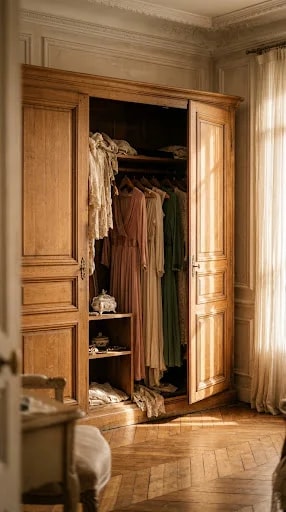
The most convincing vintage wardrobes rarely announce themselves as new. They sit in a corner as if the room grew around them, their doors echoing the panelling of the walls, their frames flush with the skirting. In this corner, two carved doors in warm honey oak do exactly that: the left one closed, showing raised rectangular panels and a soft hand-rubbed sheen, the right one swung open to reveal the working heart of the piece. It is a reminder that vintage style in built-in carpentry is less about ornament than about proportion, and about letting the wood keep the room's original voice.
Look closely at the open side and the practical logic becomes clear. A short hanging run holds a handful of dresses in dusty rose, cream and olive green, spaced generously so nothing crushes; above them a single shelf carries folded linens and a small ceramic dish for stray buttons and pins. That restraint is deliberate. Period wardrobes were built for fewer, better garments, and copying that shallow depth keeps the silhouette narrow enough to fit a corner without swallowing the floor. If you are planning your own, measure your longest dress, add a hand's width, and let the shelf above do the rest of the work.
The detailing carries the vintage mood: carved capitals at the top of each stile, a moulded cornice that meets the plaster without a visible gap, and a door panel profile borrowed from the room's own wall panels. Paint is the other lever. Honey oak suits a warm, sunlit corner like this one, where light through a sheer curtain gilds the grain each afternoon, but the same carcass in a soft sage or aged cream with a waxed finish reads just as period-correct and can sit more quietly beside floral wallpaper.
Inside, keep the palette muted and let it echo the room. The dresses here pick up the ambers and greens of the parquet herringbone underfoot, so the open door reads as part of the decoration rather than a storage reveal. A small dish, a linen stack tied with cotton tape, a lavender sachet on the shelf: these are the details that make an old wardrobe feel lived in rather than staged.
Finally, think about the closed door as a piece of furniture in its own right. Raised panels catch the light and give a flat wall rhythm, and a simple turned or brass knob finishes it without fuss. When the door is shut, the wardrobe should look like joinery that has always belonged; when it opens, it should feel like a small, calm dressing room. That double life is what makes built-in vintage wardrobes worth the cabinetmaker's time.