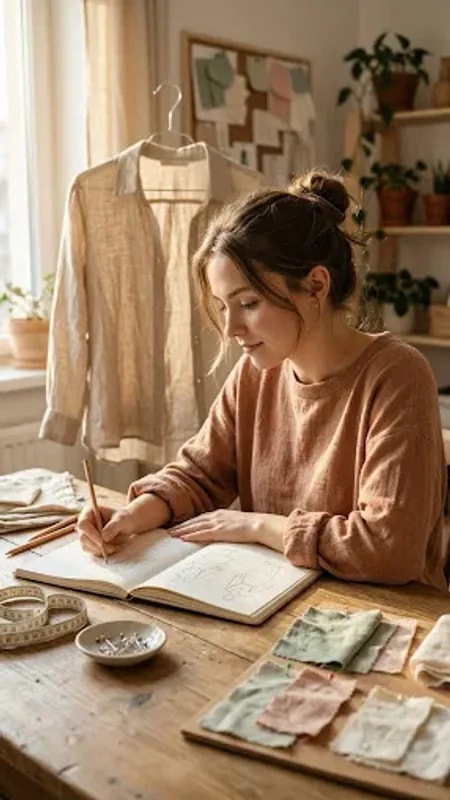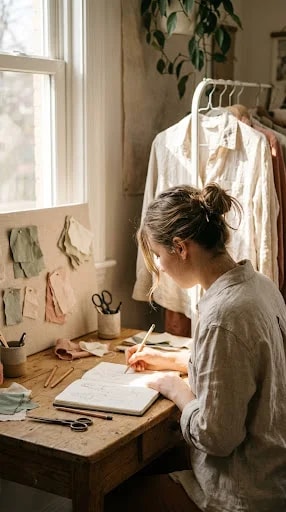
There is a particular kind of stillness that arrives when you sit down at a wooden desk with an open notebook and a wardrobe within arm's reach. No shopping tab open, no cart waiting. Just the linen on the rack behind you, a few fabric swatches pinned to the wall, and a pencil that needs sharpening. This is where a wardrobe journal earns its keep: not as a wish list, but as a record of what you already live in and why it works.
Start with the rack instead of the store. Pull three pieces you wore most this month and lay them out, then sketch each one loosely — a shoulder line, the fall of a sleeve, the way a hem sits. Perfection is beside the point. What matters is that your hand learns the shape of a garment your eye has been skimming past for months. Note the details that keep earning their place: the slightly dropped armhole, the fabric that softens after washing, the length that works with flat shoes. Beside each sketch, write one sentence about when you last wore it. Those sentences are the real inventory.
Fabric swatches pinned above the desk do something a photograph cannot. They let you compare a cream against a beige against a sage without a screen interfering, in the same light you dress in. Snip a small square from a worn hem, a sample card, or a thrifted remnant, tape it to the page, and write next to it what it felt like to wear. Scratchy at the collar? Beautiful but impossible to iron? Honest notes like these quietly retire bad purchases and protect good ones from being duplicated by accident.
Leave room for the almost-thoughts. Half an idea about shortening a dress, a note that your winter palette gets muddy under grey light, a sketch of a neckline you saw on a stranger and want to adapt. Nothing needs to be resolved in one sitting. A journal that stays open on the desk accumulates these fragments until a pattern appears, and the pattern is usually simpler than you expect: fewer colours, better fabrics, more repetition of the shapes that already fit.
The discipline is small enough to keep. Ten minutes with a pencil, a handful of swatches, and the clothes you already own. Over a season, the pages turn into something more useful than any mood board — a working map of a wardrobe that looks like the person sketching it.