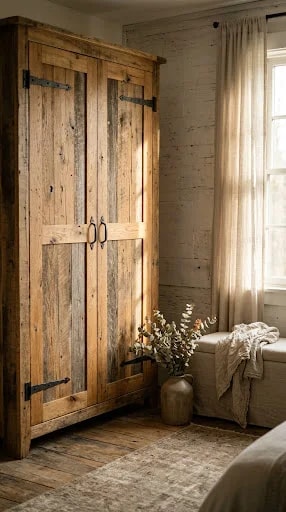
Some rooms are built around a sofa or a rug. This one is built around a wardrobe. The armoire stands tall against whitewashed planks, its two paneled doors carrying the marks of old timber — knots, faint saw scars, a grain that shifts from honey to weathered brown depending on where the daylight lands. Black iron hinges run down one edge, curved metal handles sit at waist height, and the whole thing reads less like storage and more like architecture. Nothing else in the frame competes with it, which is precisely why it works.
A piece this size earns its keep by doing three jobs at once. It gives the eye a vertical anchor in a room with a low ceiling line, it swallows the clutter that would otherwise spread across chairs and hooks, and it lends the space a sense of history that new furniture rarely manages. Placement matters more than shopping. Leave a hand's width of wall visible on both sides so the armoire reads as a freestanding object rather than something wedged in. Set it slightly off-center, as here, with a window taking the right side of the frame, and the composition relaxes instead of feeling symmetrical and stiff.
The bench beside it does quiet work. A low upholstered seat, a throw draped so the fringe just grazes the floor, a ceramic vase of dried eucalyptus leaning at an easy angle — three textures, three heights, no crowding. The temptation with rustic furniture is to pile on more rustic: burlap, stenciled signs, a wagon wheel. Resist it. The throw should look dropped rather than arranged, and the vase should hold something that dries well, because fresh flowers in a room this warm and muted would shout.
Look closely at the hardware and you learn what to hunt for. The hinges are hand-forged, slightly uneven, darkened with age rather than painted black last weekend. The handles curve outward like a bent spoon. If you are sourcing a new armoire, choose one whose metalwork is either genuinely old or honestly simple — decorative scrollwork dates quickly. And if you find a piece with good bones and tired finish, wax it rather than paint it. Feed the wood, buff it back, and let the pale patches stay where they are. That wear is the story.
The light finishes the room. Sheer cream curtains soften the window into a wash rather than a beam, casting gentle side shadows that make the wood grain visible from across the floor. Wide boards underfoot and a woven rug ground the base of the armoire so it does not float. You can reproduce the whole feeling in a plain modern apartment: one tall wooden piece, black metal accents, a low bench, one dried branch, and a window you refuse to cover with anything heavier than linen. Warmth like this is not a style. It is a decision about how much you are willing to leave out.