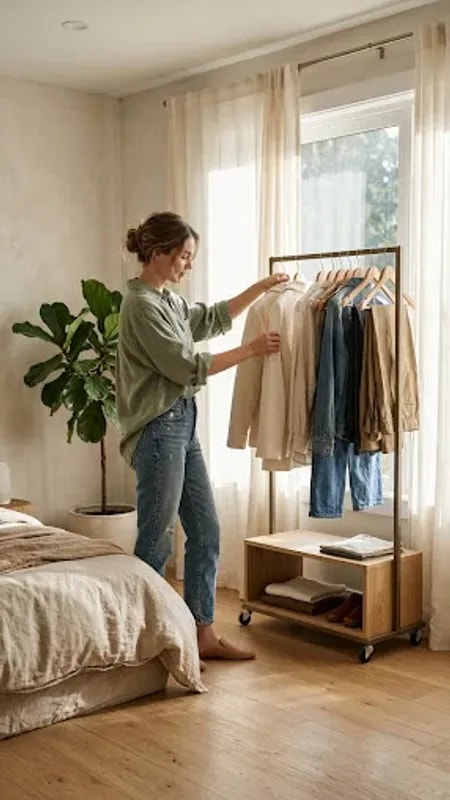
Some bedrooms keep their clothes behind closed doors, and some put them on display. The shelving unit in this scene belongs firmly to the second camp: a simple wooden frame holding folded sweaters, blankets and linens in plain view, close enough to the bed that getting dressed feels less like a chore and more like part of the morning. Open storage only works when the contents are worth looking at, which is why the appeal here is as much about editing as it is about shelving.
Notice how narrow the palette is. Whites, creams, oatmeal and a whisper of soft blue, all sitting against pale wood. That restraint is what makes a pile of sweaters read as a design decision rather than laundry waiting to be put away. If your own shelves look muddled, pull everything out and sort by colour instead of by category for a week; you will see immediately which pieces fight the room and which ones settle into it. The oversized knit set the woman is wearing is no accident either — she is dressed in the same tones as the shelves, so she blends into her own storage in the nicest possible way.
Practical numbers matter more than mood boards. Bedroom shelving for folded clothes wants a depth of roughly 30 to 35 centimetres so stacks sit flush and nothing disappears at the back, with 30 to 40 centimetres between shelves for knitwear and more for blankets. Keep stacks to three or four items; anything taller topples the moment you pull from the middle. Reserve the lowest bay for a woven basket, which swallows off-season layers without adding visual noise, and give a small ceramic cup a spot on top for rings, hair pins and the earrings you take off at night.
Open shelves collect dust, so build a five-minute weekly habit with a dry microfibre cloth, and tuck a cedar block or lavender sachet between the blankets. Twice a year, when the season turns, empty one bay at a time and ask the hard question about every piece. The rule that keeps these units beautiful is simple: nothing new goes onto the shelf until something else leaves it. Fold with the cut edge facing out, keep the fold lines aligned, and the shelves will look intentional even on a rushed Tuesday.
What makes this corner feel calm is not the furniture but the pace of it — someone taking her time with a stack of clothes, sheer curtains softening the window light, a plant leaning toward the glass. A wardrobe you can see is a wardrobe you have to tend, and that small daily tending is the whole point.