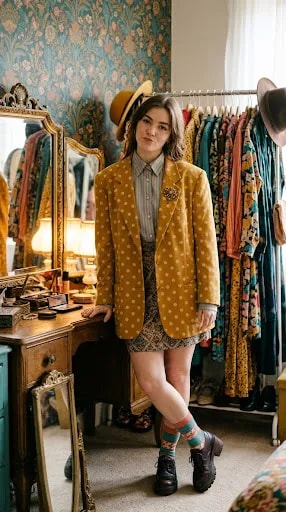
The outfit in the mirror works because it is not random. An oversized mustard blazer scattered with polka dots sits over a striped collared shirt, and the two prints only survive each other because their scales are so different. That is the first rule of clashing on purpose: match the volume, not the motif. A bold dot wants a fine, narrow stripe beside it. Two prints of the same size fight for the same oxygen, and the eye has nowhere to rest.
Start with one piece you genuinely love and treat it as the loudest voice in the room. Here it is the blazer, warm and slightly absurd, cut big enough to look borrowed. Everything after that gets quieter in saturation or smaller in pattern, never both. The patterned mini skirt is busy but short, so it reads as a hem rather than a second headline. The striped socks pick up the shirt's rhythm at the ankle, tying the top and bottom together without adding a new idea. A single brooch does the work of three accessories, and the chunky black boots give all that color somewhere solid to land.
Texture is the quiet partner to pattern. Wool blazer, crisp cotton shirt, slick skirt, ribbed sock, scuffed leather boot: five surfaces, five different catches of light. Under a warm lamp beside an ornate vanity, that mix is what makes the look feel lived-in instead of costumed. If a combination ever feels flat, the fix is usually a texture swap rather than another print. Swap the smooth skirt for something quilted, or the cotton shirt for a washed linen one, and the whole thing sharpens.
Color needs a spine too. Choose three anchors and let the prints carry them. Mustard, teal, and rust hold this outfit together while pink and cream keep it from going heavy. When you shop a clothing rack stuffed with florals, hats, and dresses, hold each candidate up against your three anchors before it earns a hanger. That one habit keeps a collected wardrobe from sliding into clutter.
Finally, give the outfit somewhere to be seen. A room with floral wallpaper, a gold-framed mirror, and a leaning glass is not a backdrop, it is a collaborator. Dress for the space you actually live in, let the prints argue a little, and walk out like the argument was the plan all along.