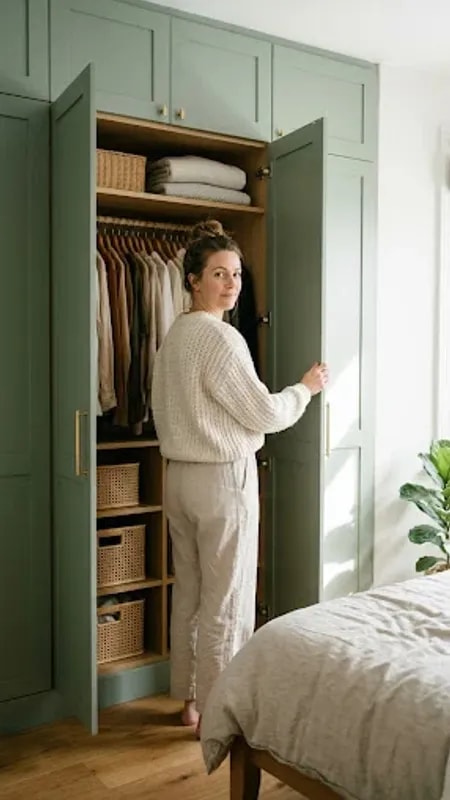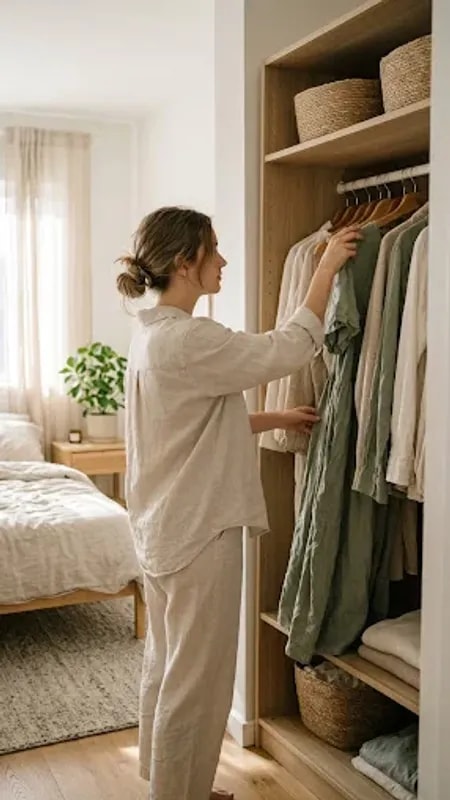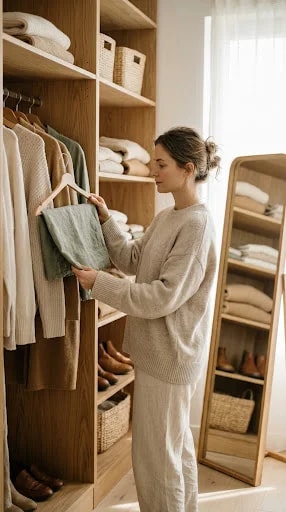
There is a specific kind of quiet that lives in a well-kept closet. A woman stands in the soft light spilling from the window, holding a muted green garment on a wooden hanger at arm's length, not quite deciding. Around her, folded oatmeal sweaters sit in tidy stacks, woven baskets hold the things that don't deserve a hanger, and a full-length mirror doubles the room so she can see the whole picture at once. This is not shopping. This is editing, and it is the most underrated step in building your own wardrobe.
Most people build a closet by addition — another top, another pair of boots, another maybe. The hanger test flips that instinct. Before anything earns a place on the rail, it has to answer three questions honestly. Does it fit the body I have this week, not the body I'm planning to have in March? Does it work with at least three things already hanging here? And would I buy it again today, at full price, with my own money? A garment that fails two of the three is not a bad purchase; it is simply finished, and finished things take up space that better things could use.
Wooden hangers do more than look calm. They force a kind of uniformity that makes the rail readable at a glance, so you can spot the gaps and the duplicates without digging. Match the hanger to the weight of the garment — sturdy shoulders for knits and jackets, slim ones for silk — and suddenly the closet tells you the truth about what you actually wear. The same logic applies to the rest of the room. Baskets corral the small things so they don't scatter. Folded neutrals sit where you can see the colors. Shoes stay visible, because a pair you can't see is a pair you won't wear.
The palette in a room like this is not an accident. Cream, soft brown, sage, and a warm oatmeal base do most of the work, which means almost everything hanging on the rail already agrees with everything else. Choosing a narrow color range is the quiet shortcut to a wardrobe that assembles itself in the morning. It also makes the occasional statement piece — that green dress, for instance — feel deliberate instead of random, because it has a calm backdrop to stand against.
Keep the ritual small and repeatable. Twice a season, take twenty minutes, turn every hanger backward, and see which ones are still facing the wrong way at the end of the month. Keep a basket by the door for the maybes. Stand in front of the mirror and ask the questions again. Building your own wardrobe isn't a single overhaul; it's a habit of small, honest decisions made in good light.