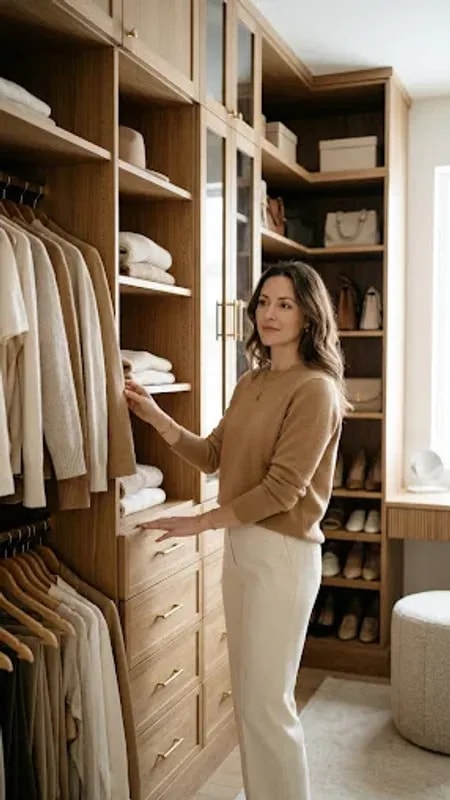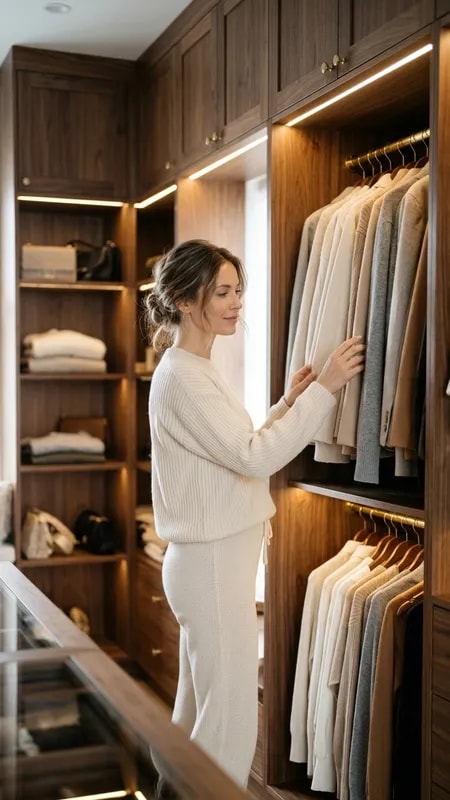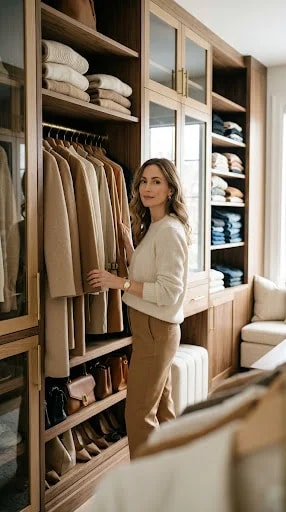
Most wardrobe advice starts with the empty room: how many meters of rail, how many shelves, how much shoe capacity. But the truest test of a closet happens at 7:40 on a Tuesday morning, when you are standing half-dressed with one hand resting on a row of hangers, deciding. Design for that moment and everything else falls into place. The woman in this closet is not surveying her storage; she is in the middle of a small, calm decision, and the room is arranged to make it easy.
Start with reach zones rather than wall measurements. Anything you wear weekly belongs between hip and shoulder height, where your hand naturally lands without stretching or crouching. In this system, the jackets and folded sweaters sit exactly there, grouped by weight and tone so the eye can scan a single row and be done. Handbags drop to the shelf below, where they are lifted out with two hands anyway, and shoes line the bottom, paired and facing outward. The rule is simple: the more often you touch it, the closer it sits to your fingertips.
Glass-fronted doors are the quiet hero of this layout. Solid doors hide clutter, but they also hide your options, which is why so many beautifully built closets end up with clothes piled on the ottoman instead. Panelled glass keeps the dust off while letting you see the whole wardrobe at a glance, and when the frames are made from warm wood with visible grain, the cabinet reads as furniture rather than utility. Choose a reeded or lightly frosted glass if you want softness, clear glass if you want the styling to do the talking.
Give the room a place to pause. A low upholstered ottoman does more than fill floor space: it holds the sweater you are considering, gives you somewhere to sit while pulling on boots, and breaks up the vertical wall of cabinetry. In narrow walk-ins, keep it small and round so you can still move past it, and leave the floor beneath it clear so the eye reads openness rather than obstruction.
Finally, let the palette work with your clothes instead of competing with them. Cream, camel, and honey-toned wood form a background that flatters almost any garment and makes even a modest wardrobe look curated. Keep hardware minimal, repeat one material across shelves and door frames, and let diffused daylight do the rest. The result is a closet that feels less like storage and more like the first good decision of the day.