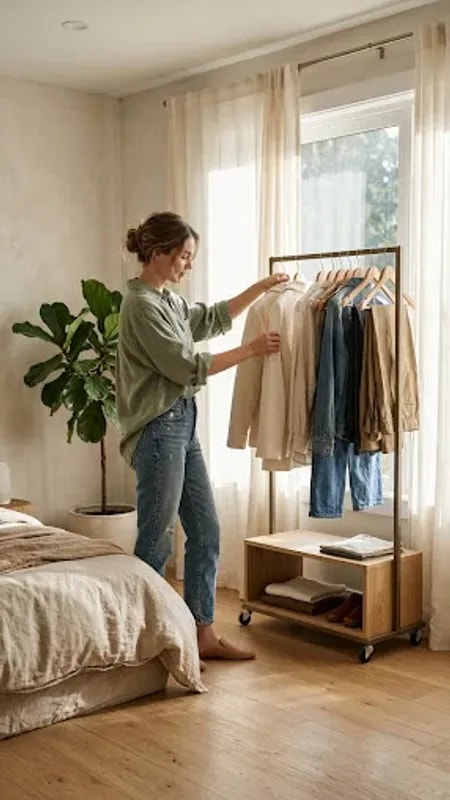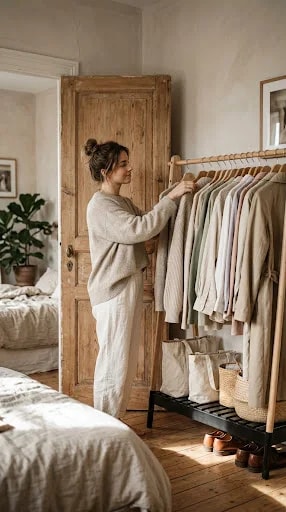
There is a particular kind of quiet that settles over a room when storage stays simple. A wooden rack, a few good hangers, and an open door letting light spill across the floor can do more for a bedroom than a wall of closed cabinets. Placing the wardrobe right beside the doorway keeps everything you reach for most within arm's length, and it turns a forgotten corner into the calmest part of the morning routine.
The door-adjacent spot works because it is already in motion. You pass it on the way out, so the pieces hanging there actually get worn instead of buried. Position the rack just to the side of the frame, leaving enough clearance for the door to swing freely — a hand's width is usually plenty — and let the opening act as a natural frame around the clothes. Light from the hallway or a nearby window will pick up the texture of knits and linen in a way overhead lighting never does.
Editing is everything with an open rack. Choose a narrow palette of cream, oatmeal, sage, and soft camel, and the clothing becomes part of the decor rather than clutter. Wooden hangers keep shoulders in shape and echo the tone of the floorboards. Hang the longest pieces at one end and let shorter shirts and folded sweaters step down, so the silhouette stays airy instead of heavy. A single hook on the wall beside the rack can hold the bag you carry every day.
The space underneath is where the quiet organization happens. A woven basket corrals scarves and gloves, canvas totes lean against the wall, and a pair of leather shoes tucks beneath the lowest rail. Keeping that bottom third occupied but not crowded makes the whole arrangement read as furniture rather than storage. If patches of floor stay visible, you have struck the right balance.
Finally, treat the rack the way you would a plant: it needs a little attention to stay lovely. Once a week, return stray pieces to their hangers, shake out the basket, and wipe down the rails. Rotate heavier coats out as the season turns. A small mirror or framed print on the wall behind gives the corner depth and offers one last check before you walk through the door — which is, after all, the entire point of putting the wardrobe there.