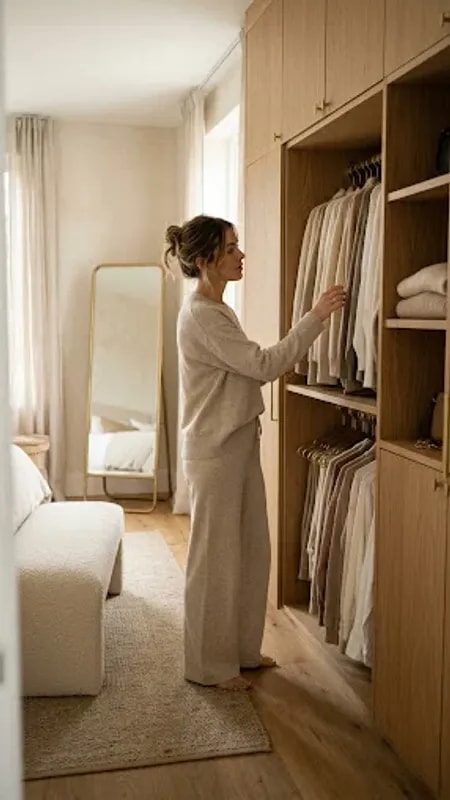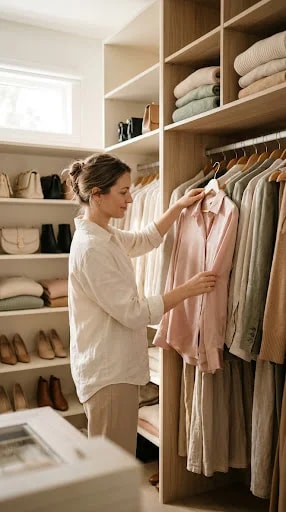
There is a particular kind of quiet inside a well-made walk-in closet. In this one, a woman with her hair pulled back stands between open wood shelving, white shirt loose at the cuff, beige trousers falling clean and straight. She has lifted a soft pink button-down from its hanger and is holding it at arm's length, thumb testing the fabric, head tilted. Behind her, folded sweaters in muted greens and creams sit in tidy stacks, handbags in white, black, and brown line a middle shelf, and below them nude heels and brown boots wait in patient rows. Light comes in from a window on the left, diffused and gentle, and the whole room seems to exhale.
What makes the scene work is not abundance. It is editing. Almost everything on those shelves belongs to the same warm, low-contrast family of neutrals, wood tones, and quiet pastels, which means nearly any two pieces can be pulled out and worn together without negotiation. The pink shirt reads as an event because nothing around it competes. That is the lesson worth stealing from wardrobe ideas pictures like this one: decide on a palette first, then let the palette do the filtering for you. A closet built on cream, oat, camel, charcoal, and denim will always feel larger and more useful than one stuffed with impulse buys in twelve unrelated colors.
The storage itself follows a logic you can copy in almost any space. Folded knitwear lives high, where it stays dust-free and out of the way. Bags sit at eye level, both to protect their shape and because they are the pieces you want to see before you reach for them. Shoes stay low and paired, heels standing heel-to-toe so the styles are readable at a glance. Hangers are spaced with a little air between them, which keeps shoulders from creasing and makes the rail feel like a boutique rather than a storage unit. Even the foreground dresser, blurred and white, earns its place by keeping the daily clutter out of sight.
Then there is the ritual. The best-dressed closets are not museums; they are workrooms where you touch things. Taking a shirt off the rail, checking the weight of the cotton, holding it against the trousers you already have on, deciding in ten seconds rather than twenty minutes, that is the payoff of an organized wardrobe. Soft light helps, because you see the true color of a garment instead of guessing under a harsh bulb.
Start with one shelf. Empty it, sort it, and put back only what you would happily wear this week. Add a single accent shade, keep the hangers uniform, and leave a little breathing room. The calm in this picture is not a budget line. It is a habit.