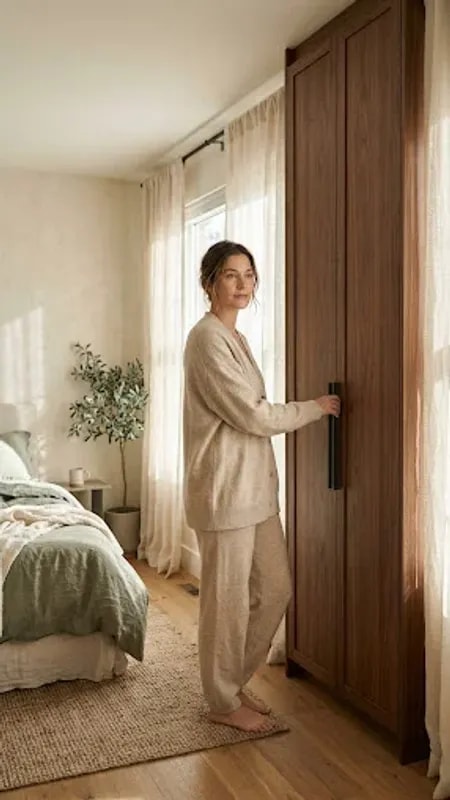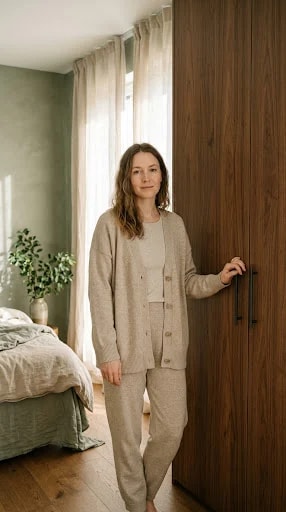
There is a particular kind of quiet that settles into a bedroom when the largest piece of furniture is also the warmest. In this room, a woman in oatmeal knit loungewear stands half-turned toward a tall, flat-paneled wardrobe, one hand resting lightly on a slim dark handle. The wood runs vertically in long, uninterrupted grain, and because the doors are plain rather than fussy, the whole volume reads as architecture instead of storage. Behind her, rumpled linen, a potted green plant, and sheer curtains let in diffused daylight that softens every edge. Nothing in the frame is shouting. That is exactly the point.
A three-door wardrobe is an underrated proportion. Two doors often feel cramped, four can feel like a wall, but three panels create a rhythm that mimics the human body — wide enough to feel generous, narrow enough to stay elegant in a room that is not huge. Here, the vertical grain does the heavy lifting: it draws the eye upward and makes the ceiling feel higher than it probably is, while the flat fronts let the piece recede so the bed stays the hero. If you are working with a similar layout, keep the doors flush, skip ornate mouldings, and let the wood be the ornament. A single long handle per door, in blackened brass or dark oak, gives the eye a vertical line to follow and keeps the surface from looking blank.
Colour is where this setup earns its serenity. Warm walnut against sage green and washed linen is a trio that rarely fails, because all three are muted, earthy, and slightly dusty rather than saturated. The wood acts as a neutral, which means you can change the bedding every season without repainting anything. Notice how the light lands on the grain — diffused daylight reveals depth in the timber that overhead bulbs flatten out. If your bedroom gets strong direct sun, consider a finish with a matte topcoat so the surface glows rather than glares, and place any greenery beside the wardrobe rather than in front of it to keep the panels clean.
Inside, the three-door layout is a natural zoning system, and it is worth planning before the wardrobe is built. One section for hanging — the longer pieces, the coats, the dresses that need air. One for folded knits and loungewear on shallow shelves, kept low enough to see at a glance. The third for the awkward middle ground: shoes on a low rail, bags, the basket of things that never quite find a home. When each door has a job, the morning stops being a search and becomes a sequence — open, choose, close. That small ritual is what makes a room feel calm rather than merely tidy.
A few details keep the whole thing working. Leave breathing room at the base with a recessed plinth so the wardrobe appears to float slightly, and choose soft-close hinges if the bedroom doubles as a place you wake up slowly. Keep the top clear unless you genuinely love the objects up there, since clutter above eye level undoes the effect faster than anything else. And resist the urge to fill every surface — a wardrobe this warm does not need decoration, only a little space around it to be seen.