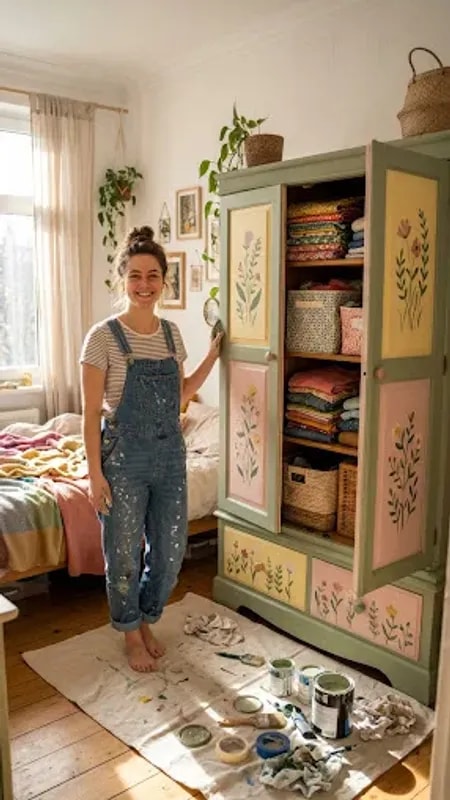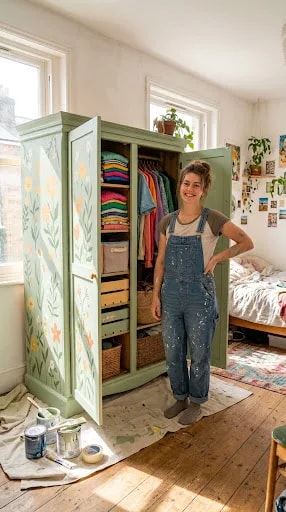
There is a particular kind of satisfaction in standing next to a wardrobe you painted yourself, brush still in hand, overalls speckled, doors open to show the clothes you already owned looking somehow better. This sage-green piece started life as plain, slightly scuffed furniture and ended up covered in loose yellow and orange flowers. The trick is that none of it required talent, a stencil set, or a big spend. A tin of leftover wall paint, two sample pots mixed together, and a handful of cheap acrylic tubes did the whole job.
Prep is where the money usually disappears, so keep it simple. Wipe the surface with degreaser, sand the glossy spots by hand with medium grit, and spot-prime any chipped edges rather than priming the entire thing. Tape the hinges and handles instead of removing them if they are stubborn, and lay a cotton drop cloth under the doors so drips land somewhere harmless. For the green, ask for mis-tinted sample pots at the paint counter or mix what you already have in the garage; a soft grey-green is forgiving and hides fingerprints far better than pure white.
Then come the flowers. Cheap craft acrylic is perfect here because it covers in two thin coats and dries fast enough to keep working. Load a round brush, press down, twist, and lift to make a rough petal shape, then repeat four or five times around a small dot of orange for the center. Practice three blooms on a piece of cardboard first, and once you trust your hand, cluster them loosely along the door edges and around the handles where scratches tend to gather. Slight wobbles read as charm, not error, especially when the flowers are different sizes. Finish with a thin coat of matte varnish or clear wax so the paint survives daily knocks.
Inside, resist the urge to overfill. Fold clothes by color so the shelves look intentional, tuck spare bedding into woven baskets, and use plain boxes on the top shelf for the things nobody wants to see. Because the exterior is busy, the interior works best when it stays calm and light. Let the doors stand open for a day or two while the varnish cures, then reattach the hardware and step back.
The whole project fits into a weekend and costs less than a flat-pack replacement. It also gives you something no catalogue can: a wardrobe that looks like it belongs to the person who lives with it, scratches, wobbles and all.