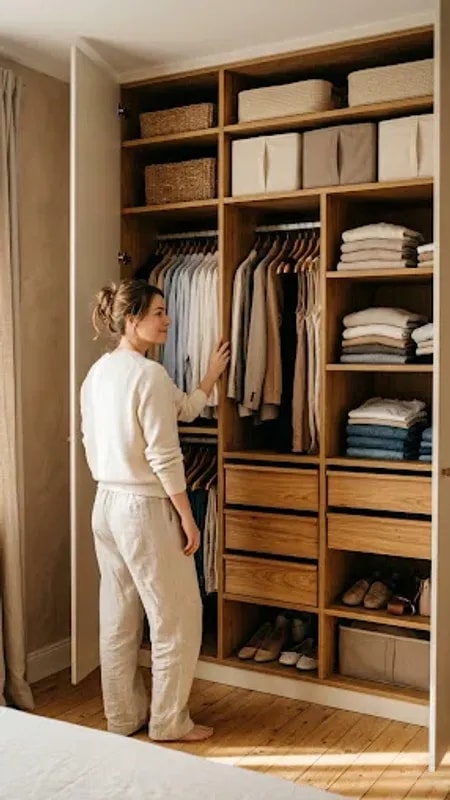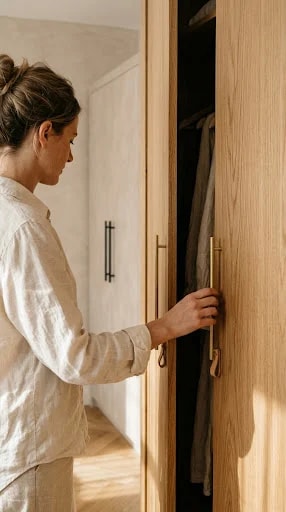
There is a moment, somewhere before coffee, when the day asks for its first decision. A woman in a rumpled linen shirt stands in profile, one hand wrapped loosely around a long brass bar, and pulls. The oak door swings wide on quiet hinges, and whatever happens next — the choosing, the folding, the abandoning of three shirts in favor of one — begins with that single point of contact. Of all the hardware in a home, the wardrobe handle is the one we touch most and notice least. Which is precisely why it deserves more thought than we usually give it.
A long bar pull earns its keep through proportion. Where a knob demands a pinch of fingertips and a small twist of the wrist, a bar accepts the whole hand, letting the door open in one unhurried gesture. The rule of thumb that cabinetmakers return to again and again is simple: the pull should span roughly a third of the door's height, set a comfortable hand's width from the edge. On a tall oak door, that means something in the neighborhood of thirty to forty centimeters — long enough to read as a deliberate line rather than an afterthought, short enough to leave the wood grain dominating the view.
Material matters as much as shape. Unlacquered brass arrives bright and slightly cold, then slowly warms toward a mellow, honeyed tone as hands and air work on it. Set against pale oak, cream plaster, and the soft diagonal shadows of morning light, that gold note becomes the only jewelry the room needs. Polished finishes throw light around and feel formal; brushed or aged finishes absorb it, which suits bedrooms better. If the wood is warm and the walls are neutral, let the metal be the one thing that catches the sun.
Notice, too, how dark the wardrobe's interior stays in a well-composed shot. That shadow is not an accident. Keeping the inside quiet — a restrained palette, a handful of wooden hangers, nothing fighting for attention — lets the door edge and its brass bar carry the visual weight. The closed wardrobe reads as furniture; the open one reads as possibility. The contrast between the deep interior and the sunlit face of the door is what makes the whole thing feel calm rather than cluttered.
When you specify the pull, think about the hand that will use it at six in the morning and again at eleven at night. Round the ends slightly so nothing bites. Check that the bar clears the door face by a finger's width so knuckles never graze the wood. And mount it at the height a person actually reaches, not the height a drawing looks balanced at. Do that, and a piece of metal becomes a small daily pleasure: the first thing you touch, the last thing you touch, quietly holding the day's edges together.