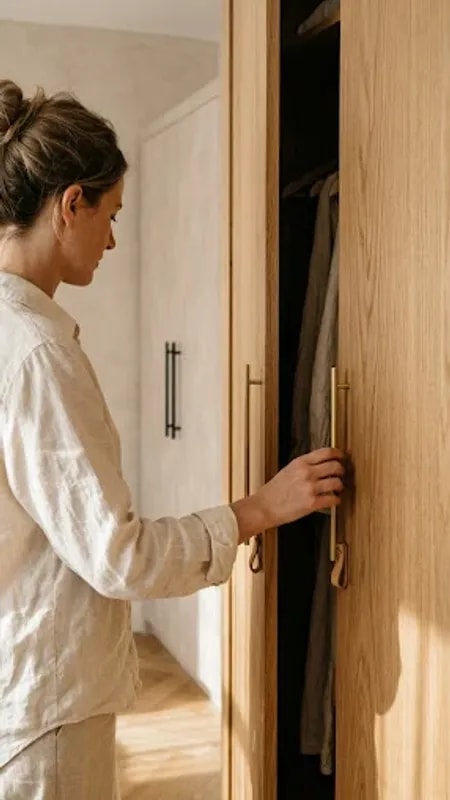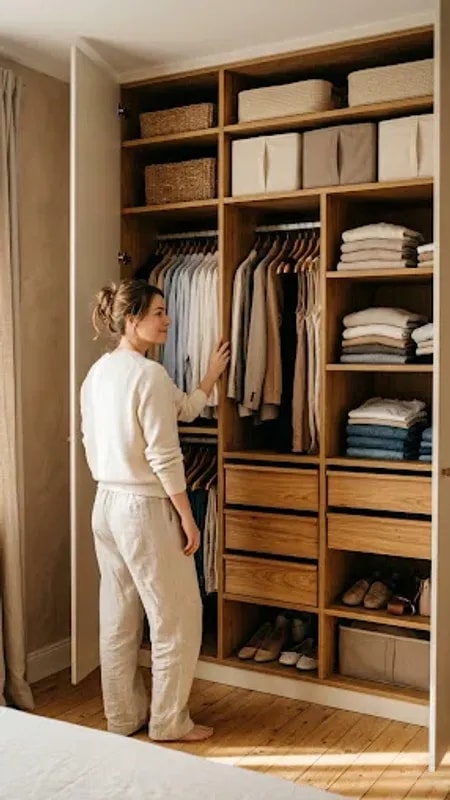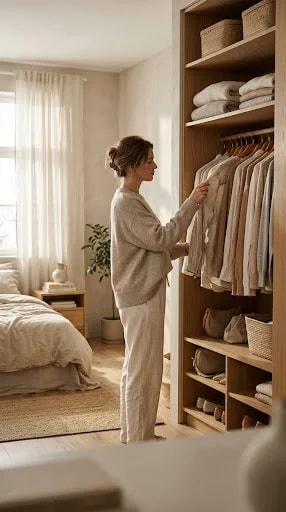
An open wardrobe has nowhere to hide, and that is precisely its charm. In this cropped view, the shelves read less like storage and more like a still life: soft stacks of oatmeal knitwear, a column of folded trousers, a few shirts resting edge to edge. Light arrives from the left and grazes every surface, so the eye registers wool before it registers shade. That is the trick worth borrowing — when a wardrobe stands in the bedroom without doors, texture becomes the organizing principle, and color recedes into a supporting role.
Start by narrowing the palette until it feels almost stubborn. Creams, beiges, light wood, and a muted grey do more than look serene; they let the differences between fabrics do the talking. A ribbed knit beside a smooth cotton poplin beside a slubby linen creates variation without visual noise. If your wardrobe holds louder pieces, give them one contained zone — a single shelf or the far end of the rail — so the calm core stays intact. The goal is not a mono-closet but a composition where nothing competes for attention.
Folding is the design work here. Keep stacks shallow enough that removing a sweater doesn't topple the pile, and align the folded edges toward the front so the shelf reads as a tidy block rather than a heap. Knitwear belongs folded, never hung, or shoulders will stretch and the shelf will lose its softness. Trousers fold best in thirds with the waistband tucked under, and shirts look cleaner when their collars are gently pressed and facing the same direction. Take five extra minutes on the fold and the shelf will hold its shape all week.
Below the shelves, the low rail stays deliberately sparse. A handful of hanging pieces, spaced with a finger's width between them, gives the garments room to breathe and lets the wall behind show through. Matching slim hangers in wood or matte black does more for the overall look than any accessory, because repetition reads as intention. Leave a little empty rail at the end; negative space is what keeps an open wardrobe from feeling like a shop floor.
Maintenance is quiet but constant. Rotate the stacks each season, tuck a cedar block into the corner, and pull anything that hasn't been worn since the last changeover. Because there are no doors to close, every item earns its place visually as well as practically. Get that balance right and the reward is a bedroom that starts each morning already composed — one soft, tactile glance before the day begins.