There is a particular kind of quiet that comes from finding furniture where it does not belong. A two-door wooden wardrobe, warm brown against all that green, planted squarely on a mown lawn with mature trees behind it and a small rug laid in front like a welcome mat. A potted plant sits on top, minding its own business. The light is soft and shadowless, the sky a muted blue-grey, and nothing about the scene feels rushed. It looks less like a mistake and more like a decision someone made calmly and then walked away from.
That is the appeal of taking a wardrobe outside: it borrows the language of a room and spends it on open ground. A rug is the cheapest wall you will ever build. Laid on grass, it marks a boundary the eye accepts immediately, and everything standing on it reads as intentional. Put a chair on a lawn and it looks abandoned. Put a rug down first and the same chair looks placed. The wardrobe in the image works because of that rug, and because of the centered, unhurried way it sits — nothing around it competing for attention.
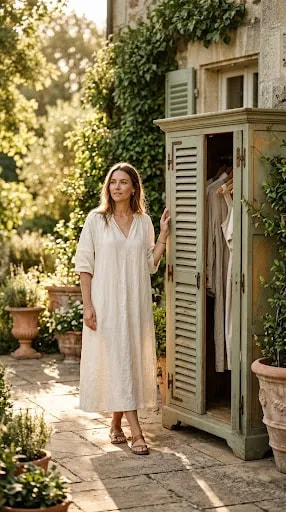
Practically, an outdoor wardrobe earns its keep as a hedge pantry. Cushions for the bench, a folded tablecloth, secateurs, twine, garden gloves, the lanterns you drag out twice a summer. Keeping those things at the edge of the garden rather than in a shed at the back saves a hundred small trips. Stand the piece on bricks or a shallow gravel pad so the base stays clear of wet grass, leave a gap behind it for air to move, and treat the wood once a year. Whatever goes inside should survive damp air, which rules out linen left over winter and argues for galvanized tins and lidded boxes instead.
The plant on top is the detail that makes the whole thing believable. A wardrobe outdoors stops looking like a stunt the moment something grows out of it, because greenery is the one thing a garden understands. Use the top as a shelf for a fern, a trailing ivy, a pot of herbs you actually cut from. Height helps too: a tall flat-backed piece gives a small garden a vertical anchor, the way a hedge or a gatepost does, without blocking a single view.
You do not need a reason beyond the pleasure of it. A wardrobe on the grass is a small, polite joke about indoor and outdoor life, and the photograph's calm is the point — no drama, no signage, just a domestic object sitting in the open as though it has always been there. Choose a piece you would not grieve over, give it a rug and a plant, and let the lawn become the room it was always pretending to be.