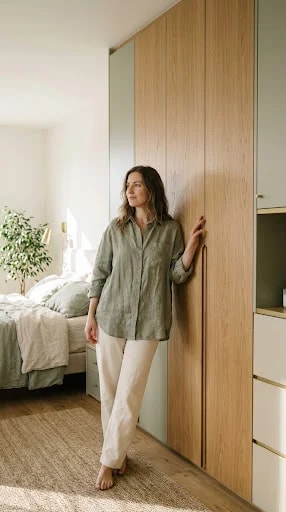
The most persuasive argument for a floor-to-ceiling built-in is not the storage count. It is the way the room feels when the cabinetry stops behaving like furniture and starts behaving like architecture. In this bedroom, flat oak panels run the full height of the wall, their vertical grain pulling the eye upward, while pale green side panels wrap the return so the unit reads as a single considered volume rather than a box pushed against plaster. The result is quiet. Nothing shouts. Everything lines up.
What makes the oak work here is restraint. The fronts are flat, without beading, moulding, or visible frames, so the grain does all the talking. Slim brass pulls sit small against those wide panels — hardware as punctuation, not decoration. If you are planning your own run of built-in wardrobe ideas, borrow that proportion: generous door widths, minimal gaps, and handles that measure no more than a finger's width. Wide panels make a room look taller; busy fronts make it look crowded. The vertical grain matters too. On a tall unit, a vertical veneer draws the ceiling up, while a horizontal one can make the same cabinetry feel squat.
The sage green is the detail that keeps this from being just another oak wall. Painting the side panels and the interior of the open niche in a muted green gives the unit depth, and it ties the cabinetry to the sage pillows on the bed and the leaves of the potted tree in the corner. That is the trick worth stealing: pick one colour from the textiles already in the room and repeat it inside the joinery. It costs almost nothing, since those surfaces are small, and it makes a large built-in feel intentional rather than installed.
Then there is the niche. A single open bay with two shallow drawers breaks up all that closed storage and gives the wardrobe a place to breathe. It is where the everyday things live — a folded throw, a dish of jewellery, the book you are halfway through — so the doors stay shut and the room stays tidy. Drawers at hip height also mean you are not crouching in the morning. Below the niche, the floor is left clear, and the jute rug runs right up to the base, softening the meeting of wood and pale floorboards.
Light does the rest. Daylight arriving from the left grazes the oak and lifts the grain, casting soft shadows down the panel joints, which is why the cabinetry looks warm rather than flat. Keep that in mind when you site a built-in: a wall that catches side light will always flatter timber more than one in shadow. Pair it with cream linen, a rumpled white bed, and one warm lamp, and the wardrobe becomes the calmest thing in the room — which is exactly what storage should be.