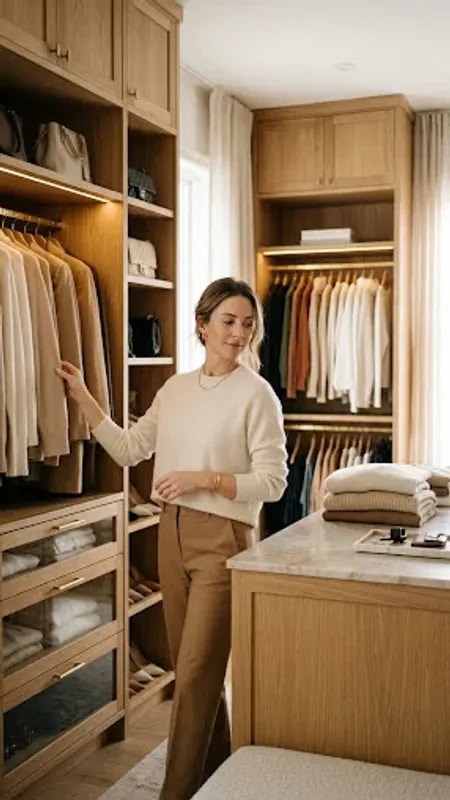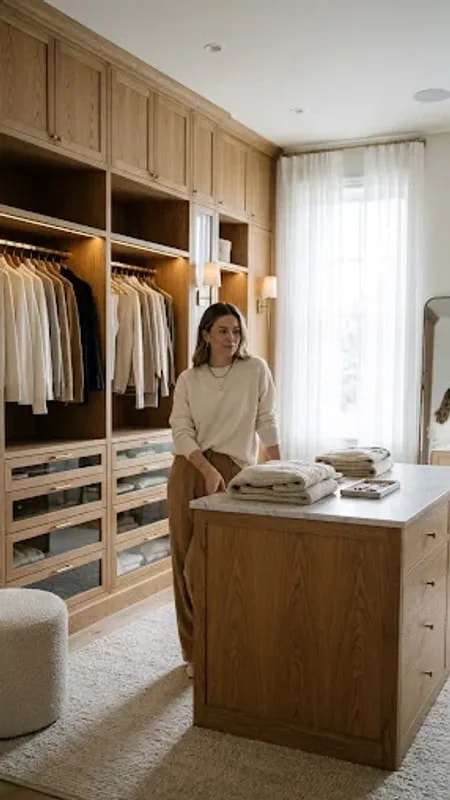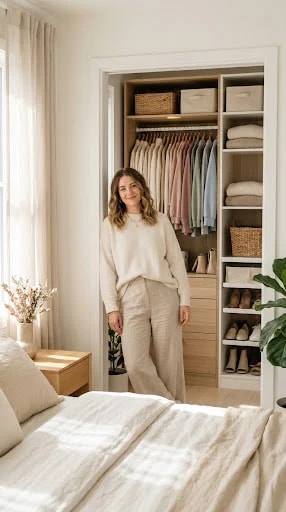
There is a particular kind of calm that comes from a closet with no door. In the image, the woman stands framed by hers, an oversized cream sweater falling loose over beige trousers, a single pendant at her throat. Behind her the wardrobe is open to the room: hanging rails of oatmeal, blush, and pale blue, folded linens stacked square, shoes lined along a low shelf, woven baskets tucked where the eye expects clutter. In front of her, a rumpled cream bed and a nightstand of dried flowers. Nothing is staged into stiffness. It simply looks like a Tuesday that happens to be beautiful.
That openness is a design decision with a useful consequence. When the closet is part of the bedroom, every item becomes part of the room's composition, so the editing has to be honest. The palette in this scene does the heavy lifting: oatmeal and cream as the base, warm wood to ground it, sage and blush as quiet accents, a hint of pale blue for freshness. Before buying anything new, pull everything you own into daylight and sort by color rather than category. The pieces that fall outside your few shades are usually the ones you skip in the morning anyway. Keep what reads softly against the rest and let the outliers go.
Infrastructure matters as much as the clothes. Matching slim hangers do more for a rail than any amount of rearranging, because they let garments sit at an even height and create the visual rhythm that makes a closet look cared for. Woven baskets absorb the awkward items — scarves, swimwear, the second-tier knitwear — without adding visual noise. Fold knits and linens rather than hanging them, and give them a shelf with real breathing room; a stack that is slightly too tall always collapses into a mess by Thursday. Shoes belong on a low shelf where you can see the pairs at a glance, not in boxes you have to open. Drawers should hold the small things: belts, undershirts, the jewelry you actually wear.
The outfit itself is the argument for all of this. An oversized knit, a relaxed trouser, and one piece of jewelry is a formula that survives errands, coffee, and a video call without a change of clothes. It works because the proportions are generous on top and easy on the bottom, and because the neutrals mean nothing clashes when you grab in the dark. Build three or four versions of this uniform in slightly different weights and you will stop standing in front of the rail at 7:40 in the morning.
One small ritual keeps it sustainable: a ten-minute reset each Sunday. Rehang what drifted, refold the leaning stack, put the baskets back in their places, and open the curtains so the light does the rest. A closet that faces the room rewards you for that attention every single day.