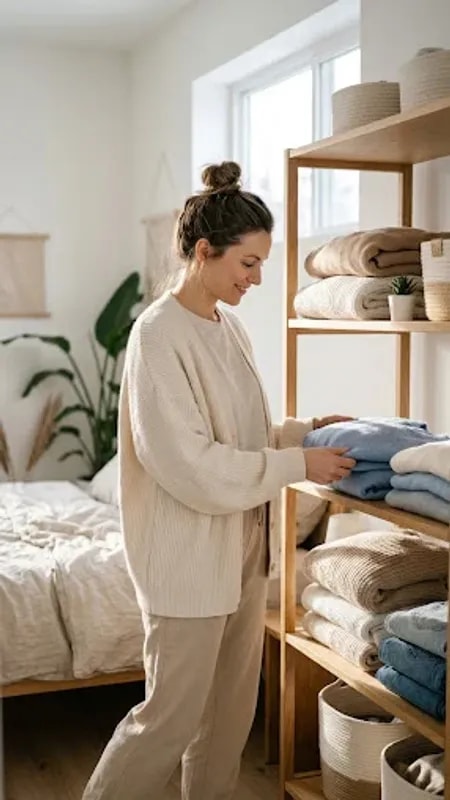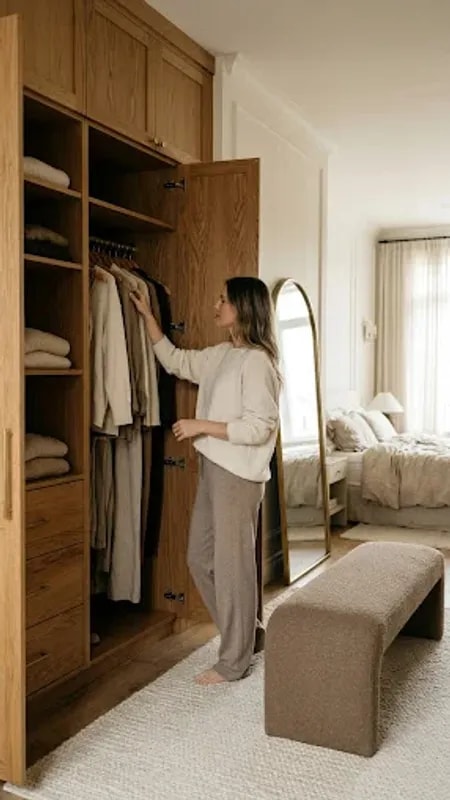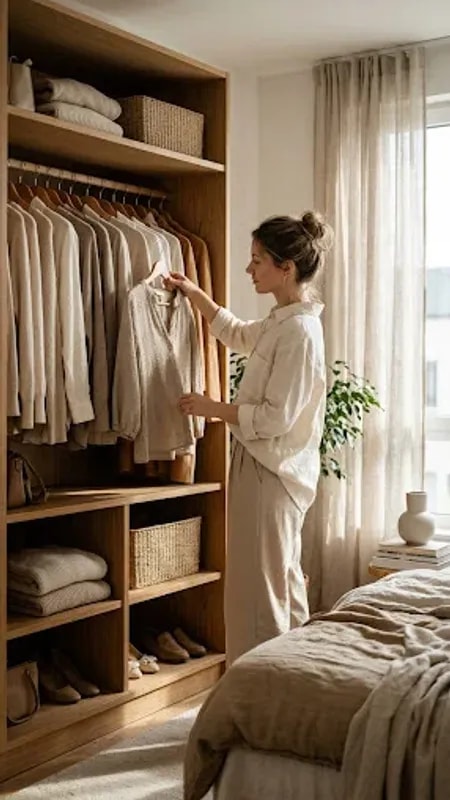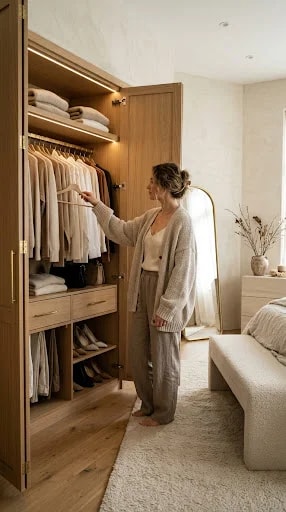
There is a particular kind of quiet in a master bedroom where the wardrobe stands open. A woman in soft loungewear, barefoot on warm wood, holds a single hanger and studies the rail before her. Nothing is hurried. The clothes hang in oatmeal and cream, towels sit folded in neat stacks, and a row of handbags rests on a shelf like objects in a shop window. Integrated lighting runs along the top of the unit and turns the whole thing into a soft lantern, so the act of choosing an outfit becomes the gentlest part of the morning rather than a chore tucked away behind closed doors.
That is the argument for treating an open wardrobe as furniture, not storage. When the closet lives inside the bedroom, everything on display has to earn its place. Light wood — oak, ash, whitewashed birch — keeps the volume from feeling heavy against a wall, especially when it reaches nearly to the ceiling. Open shelving above the hanging rail gives you room for the things you actually like looking at: a stack of folded linen towels, a woven basket, two or three bags in rotation. Shoes lined along the base read as a collection rather than clutter. The trick is the drawers. Every open wardrobe needs a closed section for the unglamorous stuff, and lower drawers hidden behind a plain wood front are where the socks, workout clothes and paperwork disappear.
Editing is what makes the difference between a styled wardrobe and an exposed mess. Work in a palette that matches the room: oatmeal, cream, beige, warm white. Swap mismatched plastic hangers for a single matching set, and thin them out so the rail has air between garments. Roll the things that fold, keep the shelf heights consistent, and leave one empty shelf as breathing room. A wide drawer dedicated to folded knits and a small tray for jewellery on top of the dresser complete the picture without adding visual noise.
What surrounds the wardrobe matters just as much as what sits inside it. In a well-planned master bedroom, the closet zone bleeds into the rest of the room without a hard line. A full-length mirror leans nearby so you can see the whole outfit at once. An upholstered bench at the foot of the bed gives you somewhere to sit while pulling on boots. A dresser with a vase of dried branches anchors the opposite wall, and a textured rug underfoot softens the transition from carpet to wood. Bed linens in the same warm neutrals tie the far side of the room back to the wardrobe, so the whole space reads as one considered composition.
It is a small daily ritual, but it changes how a bedroom feels. Instead of a door you close on chaos, you get a corner that looks intentional at seven in the morning and again at ten at night. Choosing what to wear becomes a minute of quiet rather than a scramble, and the room itself stays serene because the wardrobe was designed to be seen.