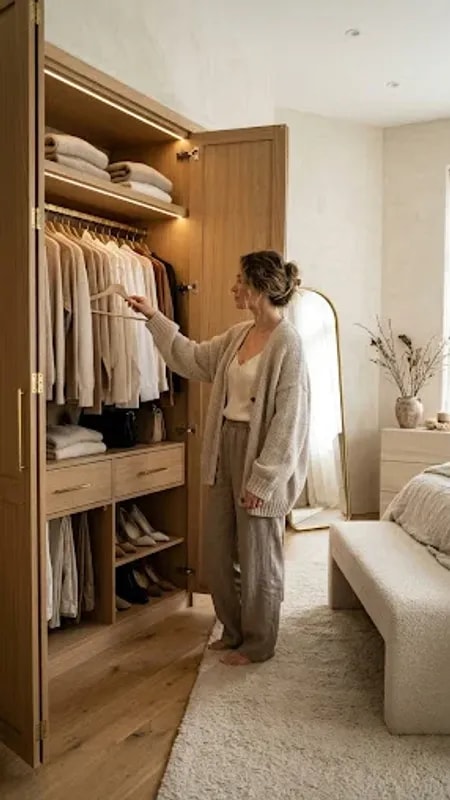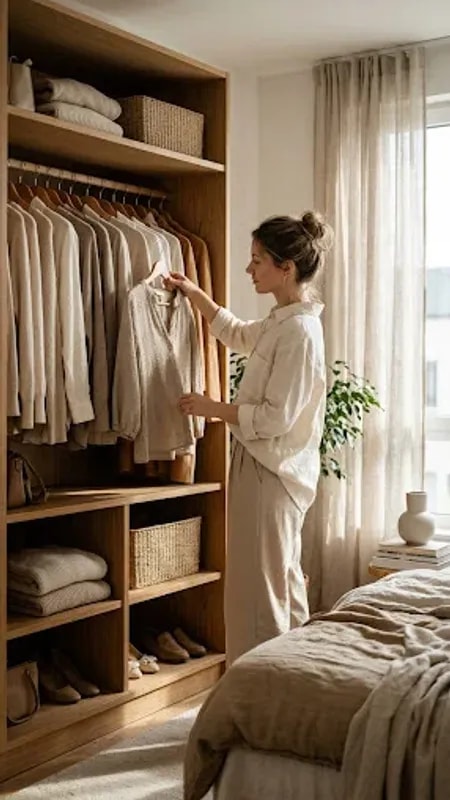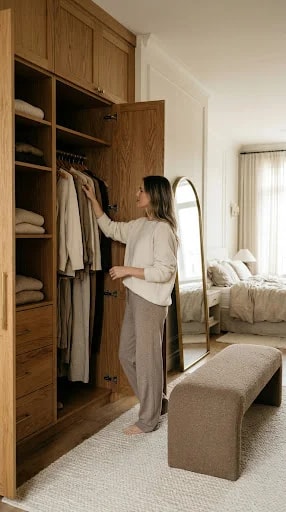
Most master bedrooms have one awkward corner: the sliver beside the door, the wall that stops short of the window, the spot where a nightstand does not belong. This image shows what happens when that leftover space is treated as a real room instead of an afterthought. A floor-to-ceiling built-in with white paneled doors runs the full height of the wall, the dresser sits beneath a large round mirror, and a low wooden stool finishes the arrangement. Nothing is decorative for its own sake, yet the result feels finished rather than utilitarian.
The built-in does most of the quiet work. Because the doors reach the ceiling, there is no dusty gap to collect clutter and no visible stack of boxes on top. The paneled fronts add shadow lines and depth without pattern, so the wardrobe reads as architecture rather than furniture. If you are planning something similar, resist the urge to add open shelving at eye level. Closed storage is what keeps a bedroom looking composed on a Tuesday morning when nothing is folded properly, and a single tall run of doors is more forgiving than a mix of niches.
The dresser and mirror carry the corner's personality. Matching the dresser to the wardrobe in the same soft white keeps the zone visually continuous, while the round mirror breaks up all those vertical and horizontal lines and bounces window light deeper into the room. A thin black frame gives the eye one crisp point of contrast, which matters in a palette of whites and warm woods. Mount the mirror low enough that you can use it while standing at the dresser, and keep the surface mostly clear: a tray, a small lamp, one scent bottle. The stool earns its place because it slides under when not in use, giving you a seat for shoes without stealing floor space from the walking path.
What makes this corner feel calm is not the amount of storage but the absence of visual noise. Every element is the same family of white, the only wood is warm and quiet, and the mirror reflects light instead of more objects. Try that test in your own bedroom: stand in the doorway and count how many different finishes, handles, and labels you can see. Each one is a small interruption. A single coordinated wardrobe wall, a dresser that echoes it, and one well-placed mirror can absorb a surprising amount of clothing and still leave the room feeling like somewhere you would want to wake up.