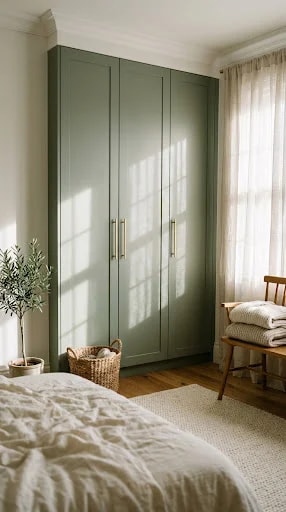
For anyone who has stood in a bedroom weighing up storage, three doors tends to be the sweet spot. Two doors rarely cover a couple's worth of clothes, while four can swallow an entire wall and leave the room feeling like a corridor. A three-door wardrobe lands in the middle: generous enough for hanging, folded stacks and a drawer or two, yet slim enough to leave breathing space beside the bed. The version that reads calmest is quiet in every sense — a flat matte front in white, soft grey or pale oak, a slim recessed plinth, and a top that meets the ceiling or stops just below a picture rail with a single plant and a small stack of books resting on it.
Think of the three doors as three different jobs. The middle door is the one you open most, so give it the everyday pieces: work shirts, the jeans you live in, a shelf for folded knitwear. The outer doors hold what you reach for less often — occasion wear, out-of-season coats, spare bedding and bags. Inside, a simple vertical split works well: full-height hanging on one side, half hanging with shelves above on the other, and a bank of three or four drawers at the base of the middle section for anything small that would otherwise drift. Keep the logic consistent rather than labelling everything, and the wardrobe will still feel intuitive months later.
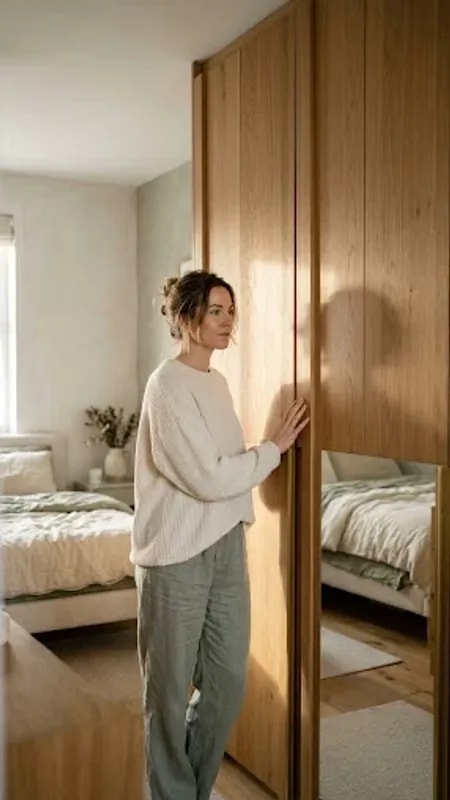
Details are what make a three-door unit look built in rather than bought. Handleless push-to-open fronts keep the surface unbroken, especially in a small room where hardware adds visual noise. A fluted or reeded finish brings texture without pattern, while a mirrored middle door bounces light into a dim corner and gives you a full-length view at the same time. Taking the unit to the ceiling with a shallow top box for suitcases and winter duvets removes the dust trap and makes the proportions feel architectural. A plinth set back from the front edge helps the wardrobe sit lightly instead of looming.
The styling around the wardrobe matters as much as the wardrobe itself. Resist the urge to fill the top with storage boxes; one ceramic vase, a trailing plant or a couple of art books is plenty, and the empty space beside them is doing real work. Keep the run of floor in front clear, let the bed sit a comfortable arm's length away, and choose bedside lighting that does not compete with the clean lines of the doors.
Before committing, check the practicalities: an internal depth of at least 60cm for a standard hanger, soft-close runners on drawers, and a little ventilation so clothes stay fresh. Measure the swing of nearby doors and the height of your ceiling, and decide early whether the frame sits flush to the wall or stands proud as a freestanding piece. Get those right and three doors will quietly do the job of a much larger closet, without taking over the room.