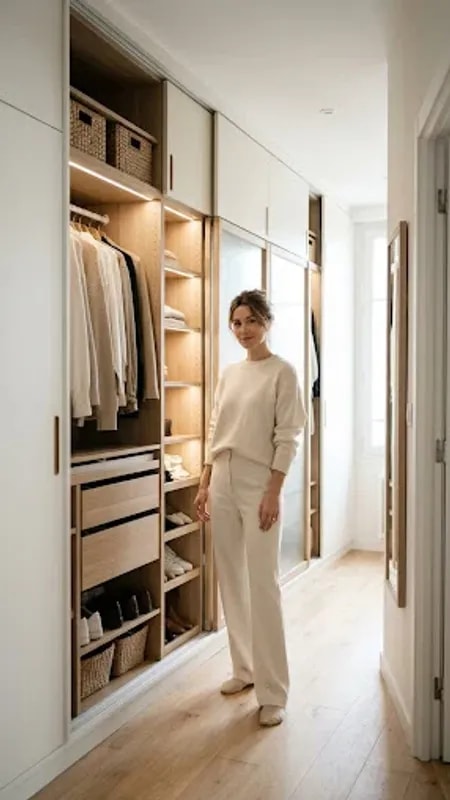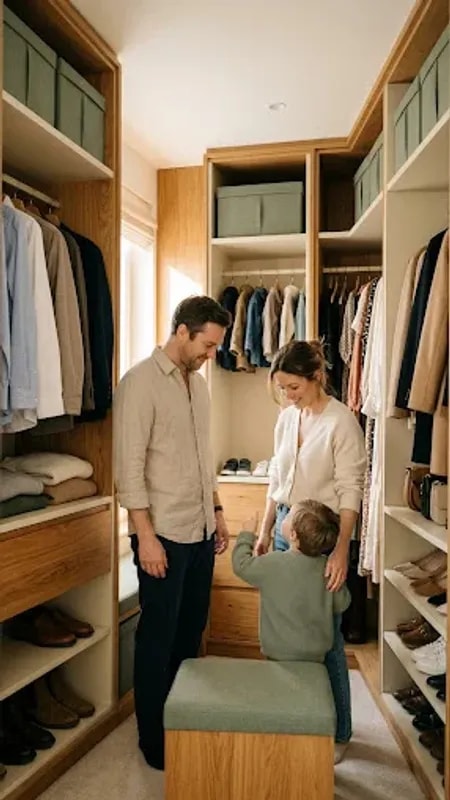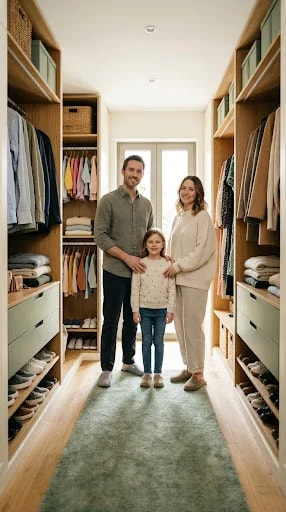
Stand at the mouth of this closet and the whole plan reveals itself in one glance: a long sage-green runner pulling the eye straight down the middle, oak shelving stacked symmetrically on either side, and at the far end, glass doors letting in daylight behind the three people who share it. It is a corridor, not a room, and that is precisely why it holds a family of three without feeling crowded. The aisle is doing the heavy lifting. Everything else is arranged around keeping it empty.
Clearance is the first rule of a shared closet, and it is the one most often broken. Here the floor stays bare except for the rug, which means two people can pass, a child can crouch to reach a shoe, and nobody has to turn sideways to grab a jacket. Before you buy a single basket, measure the walkway and treat that number as untouchable. Storage that creeps into the path — a laundry hamper, an overflow bag, a stool — is what makes a three-person wardrobe feel like a squeeze rather than a system.
The symmetry on both walls is not just for looks. Matching heights on each side mean the shelves read as one continuous unit, so the space feels wider than it is and the eye stops counting storage. What differs is the assignment. Rather than giving each person a wall, divide by height and frequency: adult hanging at eye level and above, children's clothes on the lower rails where small hands can reach them without help, folded stacks at chest height for whoever dresses fastest in the morning. Shoes line the bottom in a single row per person, which keeps pairs visible and stops the pile from forming.
The low band deserves extra thought, because it is where a three-person closet either stays tidy or collapses. Woven baskets at knee height absorb the loose items — socks, hats, the odd glove — that otherwise migrate to the floor. Pale green drawers hold what does not hang well, and keeping them a consistent colour makes the whole run feel intentional rather than assembled. Up top, out-of-season clothing goes into labelled boxes, and the glass doors at the back bounce daylight onto the oak so the upper shelves never turn into a dark void where things get forgotten.
What the layout really buys you is a routine. Everyone walks the same path, passes their own section, and sees what is missing. The runner keeps footsteps quiet on early mornings, the rear light makes the far end feel like somewhere worth walking to, and the narrowness itself enforces a little discipline: nothing stays that does not fit. Three people, one aisle, and a closet that stays calm because the middle was never negotiable.