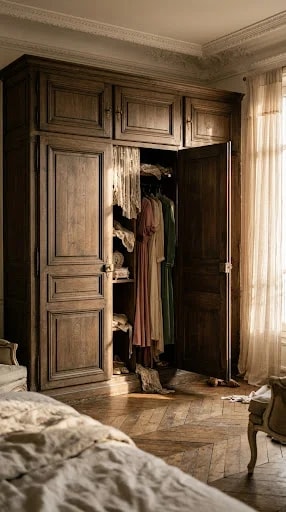
Most built-in wardrobes are designed to be closed. The panelled face does the talking, and the interior is treated as pure storage — shelves crammed, hangers jammed, the door shut before anyone can judge. The vintage approach flips that. When a wardrobe is finished in warm wood and framed by herringbone floors and sun-softened curtains, the open door becomes part of the room's composition, a small stage set worth arranging on purpose.
Start with the back wall. A vintage built-in reads richer when the interior has its own finish rather than a bare white box — beadboard, a length of faded wallpaper, or a wash of muted sage behind the hanging rail. If yours is already painted, leave it; layers of old paint are part of the charm. The goal is contrast: earthy brown paneling outside, something softer within, so the swinging door reveals a shift in tone rather than a stack of clutter.
Then treat the shelves like a still life, not a filing system. Fold linens into generous stacks, cream and ivory first, and stack them no higher than three or four deep so the edges stay crisp. Tuck lace-trimmed pieces at the top of a pile where the scalloped edge catches light. Leave deliberate gaps between stacks and let a single sachet or a small ceramic dish occupy one of them. Hanging garments work the same way: group them by tone, letting faded peach, rust, and forest green sit together, and keep a handspan of breathing room between each piece so air and light pass through.
Light does the rest. Vintage wardrobes usually live near a window with sheer curtains, and the directional glow that slides across the wood grain at midmorning is the reason the whole arrangement works. Keep the rail ends and top shelves clear of heavy boxes so nothing blocks that path of light. If the interior runs dark, a slim battery-powered strip tucked under the top shelf will mimic daylight without wiring anything into a listed building.
The last touch is the door itself. Open it to a comfortable angle, let the ornate chair beside it stay slightly out of line, and resist the urge to fill every inch. A vintage wardrobe styled this way feels like a room someone actually lives in — unhurried, a little imperfect, and quietly inviting the next glance inside.