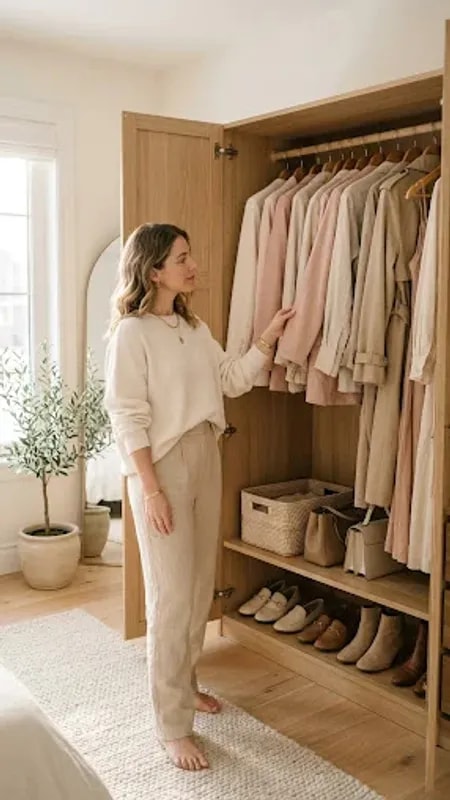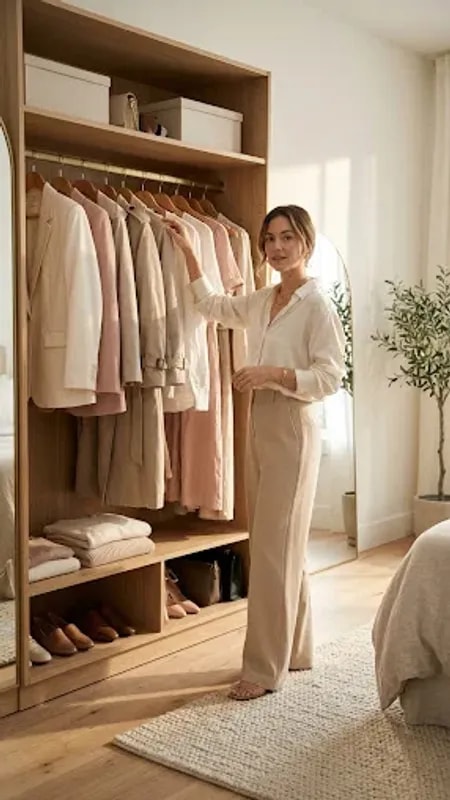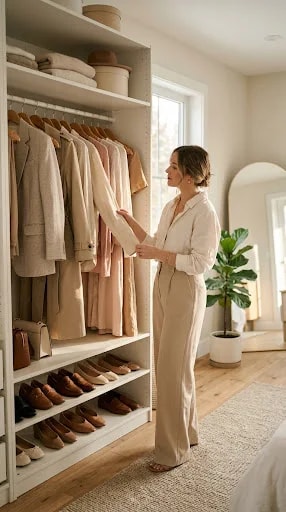
There is a particular kind of quiet in a wardrobe that has already been thought through. The unit in the room is a plain white readymade system, the sort you can order in a afternoon and assemble over a weekend, and yet it reads as something curated: linens folded to the same depth on the top shelf, a felt hat resting beside them, a rail of beige, blush and taupe hanging with air between each piece. A woman in a cream co-ord stands at the open door with one hand on a hanger, not searching, just choosing. That pause is the whole ambition of a readymade wardrobe. The structure is decided for you, so your only job is the editing.
Start with the palette, because it is what makes a modest unit look expensive. Cream, oatmeal, soft taupe and one washed blush will forgive almost any fabric and any gap in the rail, and they let you see everything at once. The trick is to be ruthless about what breaks the run: a single saturated print will pull the eye every morning and make the rest look accidental. Hang the neutrals together, longest to shortest, and let the few darker pieces sit at one end like punctuation. If a garment has not been worn since the season turned, it does not belong on the rail, however much you like it in theory.
Then work the zones from the top down. Upper shelves are for the things you want to see but not touch daily: stacked linens, spare pillows, a hat that would lose its shape on a hook. The rail belongs at eye level, with hangers that match so the shoulders sit evenly and nothing snags. Below, a low shelf takes shoes lined heel to toe beside a small leather bag, which is the one place a little leather warmth does more for the scheme than another layer of cream. Leave a hand's width of empty rail at the end. Negative space is what separates a system from a storage unit.
What surrounds the wardrobe matters as much as what is inside it. Here, a tall window throws warm, low-contrast daylight across the open doors, an arch-topped mirror doubles the light and gives you a full-length check without a second thought, and a fiddle-leaf fig contributes the only real green in the frame. That single plant keeps an almost monochrome room from going flat. If your own space runs cool or dark, borrow the idea rather than the exact palette: a plant, a mirror angled toward the window and a warm bulb overhead will do the same work.
The point of all this is not tidiness for its own sake. It is the four seconds between waking and knowing what you are wearing. A readymade wardrobe gives you the frame; the restraint you apply to it gives you the ease.